
Hold Your Horses… Er, Dogs! A Look at Safe Nail Trims
October 21, 2026 · Space Coast Claws
Hold Your Horses… Er, Dogs! A Look at Safe Nail Trims
If you've ever tried to trim your dog's nails at home, you probably know it doesn't always go according to plan. Some dogs happily offer a paw. Others suddenly remember they have somewhere else to be. And some would rather do just about anything than let someone near their feet!
At Space Coast Claws, we understand that nail trims aren't always easy. In fact, many of the dogs we work with are the very ones who have struggled to get their nails trimmed somewhere else. Maybe they're nervous, extra wiggly, sensitive about their paws, or simply not fans of the whole experience.
That's why we put so much thought into how we handle each dog. Our goal isn't just to get the nails trimmed. It's to do it as safely and comfortably as possible for everyone involved, including the dog.
Why the way we hold a dog matters
Holding a dog still might sound simple enough, but safe handling takes more thought than just keeping them from moving. Dogs can turn their heads quickly, pull their paws away, twist their bodies, or react when they feel uncomfortable. Even a sweet dog who has never shown aggression can snap when frightened or startled.
The wrong approach can put everyone at risk. A dog could injure a paw while struggling, a person trimming the nails could get bitten, or the person holding the dog could get scratched or hurt trying to prevent a sudden movement.
That's why we pay attention to the dog's size, personality, comfort level, and body language before deciding how to position them.
There's no single hold that works for every dog. Some do best standing up, others relax when lying down, and some need a little extra support to keep their paws steady. We adjust our approach based on the individual dog rather than expecting every pet to cooperate in exactly the same way.
The different ways we handle dogs during nail trims
You might be surprised by how many ways there are to position a dog for a nail trim! Here are some of the approaches we may use, depending on what works best for the dog.
1. The standing hold
For dogs who are comfortable standing, this can be one of the simplest options.
One technician helps the dog remain steady by providing gentle support around the chest and body while keeping their head and movement in mind. The other technician works on the nails, handling one paw at a time.
This position can be especially helpful for dogs who don't like lying down or feel more secure keeping all four feet on the ground.
The key is to provide enough support to help the dog stay balanced without squeezing, forcing them into position, or restricting their breathing.
2. The two-person bear hug
A bear-hug-style hold is a way of providing gentle support around a dog's chest and upper body to help manage movement during a nail trim.
One person focuses on supporting the dog and watching their body language while the other handles the paws and trims the nails. Depending on the dog, we may also work with their owner if having a familiar person nearby helps them feel more comfortable.
Having a second person makes a real difference because the person trimming the nails can focus on the paw, the nail, and the tool, while the other person focuses on the dog.
Of course, this isn't about squeezing a dog tightly or overpowering them. The hold needs to be appropriate for the individual dog, and we adjust or stop if the dog becomes too distressed.
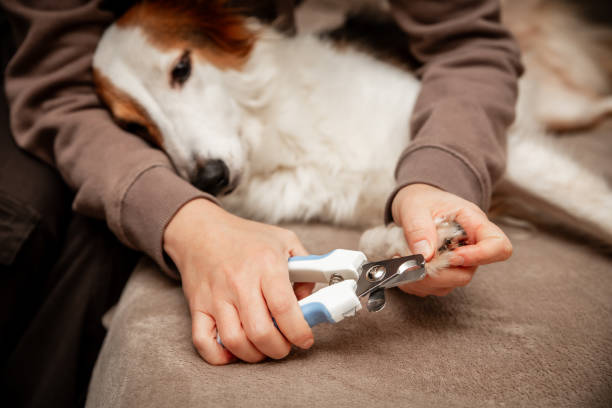
3. Side-lying positioning
Some dogs do better when they're lying on their side rather than standing.
With this approach, we gently guide the dog into a side-lying position when they are comfortable enough to allow it. This can give us better access to certain paws and help reduce the amount of balancing or awkward reaching involved.
One technician supports the dog and monitors their comfort while the other works on the nails. We take care to avoid putting body weight on the dog or forcing them to remain in a position they're fighting.
Side-lying isn't the right choice for every dog. If a dog becomes increasingly uncomfortable or struggles to get away, we reassess rather than simply holding them down harder.
4. Small-dog positioning and lap cradling
Little dogs can be just as challenging to trim as big dogs. Sometimes they're nervous, sometimes they're wiggly, and sometimes those tiny paws can move surprisingly fast!
For smaller dogs who are comfortable with it, we may use lap cradling or a supported sitting or lying position. A dog who feels secure and supported may find this more comfortable than standing on a surface or being asked to hold an unfamiliar position.
For a small, wiggly dog, we may also use gentle body positioning to limit sudden twisting while keeping the dog properly supported.
The important distinction is that we never assume a small dog will automatically be comfortable being picked up or held. We pay attention to how they respond and choose a position that makes sense for them.
5. Letting the dog choose a more comfortable position
Sometimes the best handling technique is the one that requires the least handling!
A relaxed dog might be perfectly happy lying on their belly, sitting beside us, or standing naturally while we lift one paw at a time. A dog who is comfortable with paw handling may need very little physical support at all.
Whenever possible, we want dogs to participate in their nail trims rather than simply tolerate them. That can mean allowing them to stand, giving them breaks, introducing the process gradually, and paying attention to when they need a moment.
For some dogs, a little patience and a less restrictive position can make a huge difference.
Why two technicians make such a difference
This is one of the things that really sets Space Coast Claws apart.
We always send two technicians to your appointment. You won't have one technician show up to handle and trim your dog alone.
When one person is trying to hold a dog, manage their movement, watch their head, lift their paws, operate the nail clippers or grinder, and make sure the nails are trimmed safely, there is a lot to keep track of at once.
Having two people allows us to divide those responsibilities.
One person can focus on the dog. They're watching body language, supporting the dog's position, and looking out for sudden movements.
The other person can focus on the nails. They can pay closer attention to the paw, the nail, and the trimming process.
Both people can respond quickly. If the dog shifts position or becomes uncomfortable, we can pause and adjust together.
It also means we're not asking one person to manage every part of a potentially difficult situation at the same time.
And yes, you're always welcome to help if your dog feels more comfortable with you nearby or participating in the process. You know your dog better than anyone, and sometimes having a familiar person involved can make the experience easier.
Two technicians don't mean we'll force a trim that isn't safe. They mean we have two people working together to make informed decisions and provide the best care we can.
What if your dog is scared of nail trims?
First, you're not alone. And your dog isn't necessarily being stubborn, difficult, or bad.
Nail trims can be uncomfortable or frightening for many reasons. Some dogs dislike having their paws touched. Others may have had a painful experience in the past, become frightened by the sound of a grinder, or simply feel vulnerable when someone holds their feet.
We work with dogs who have had trouble getting their nails trimmed at a groomer or veterinary office. We know that some pets need a little more patience and a different approach.
We try to make the experience as positive as possible by using calm handling, adjusting positions, giving dogs time to settle, and paying attention to their signals.
We also believe there's a difference between a dog who is nervous but can settle with support and a dog who is experiencing overwhelming fear.
If a dog is showing escalating distress, struggling intensely, or becoming unsafe to handle, continuing to hold them more tightly isn't necessarily the answer. Sometimes the right decision is to stop, change our approach, or recommend speaking with a veterinarian about additional support.
For dogs with significant fear, gradual practice and cooperative-care training can help build comfort over time. In some cases, a veterinarian may recommend medication or sedation to make necessary nail care safer and less stressful.
There's no shame in needing that kind of help. Our priority is the dog's well-being, not proving that we can finish a trim at any cost.
What about dogs whose nails really need to be done?
We understand that sometimes nail care can't be put off indefinitely. Overgrown nails can affect a dog's comfort and movement, and nails that curl into the paw pad or become damaged may need prompt veterinary attention.
We also understand that owners may be frustrated after trying multiple places without success.
We do our best to work with each dog and find an appropriate way forward. Sometimes that means using a different position, taking more time, or completing only the portions that can be handled safely.
Other times, a dog's fear or reaction may be beyond what a routine nail-trimming appointment can reasonably address.
We want to help, but we also want to be honest with you. There are situations where veterinary support is the safest next step, and we would rather recommend the right care than push a dog beyond what they can handle.
Our job isn't to judge you or your dog. It's to help you figure out the best next step.
Safety comes first, but comfort matters too
At the end of the day, safe handling isn't just about preventing bites or making sure we don't accidentally hurt a paw. It's also about how a dog feels during the experience.
We want dogs to feel as secure as possible. We want owners to feel confident that their pets are being handled thoughtfully. And we want our technicians to be able to do their jobs without putting themselves or the animals at unnecessary risk.
Sometimes a successful nail trim is a dog standing calmly while we work through every paw. Sometimes it's a dog who makes it through a few nails before needing a break. And sometimes success means recognizing that the dog needs a different plan.
We don't believe every dog has to love nail trims. But we do believe every dog deserves patience, thoughtful handling, and people who take their safety seriously.
Need help with your dog's nails?
If your dog struggles with nail trims, you're welcome to reach out to Space Coast Claws. Let us know what you've experienced, what has or hasn't worked in the past, and anything that might help us prepare for your pet.
We specialize in nail trims and work with dogs of different sizes, personalities, and comfort levels. With two technicians at every appointment, we can work together to find an approach that best suits your dog.
Let's make nail care one less thing for you to worry about.
Book your appointment with Space Coast Claws and let us help take care of those paws!